CHARLES MATSEKE | From the ballot box to the negotiating table
'Coalition negotiations often resemble the carving up of a political landscape according to power, territory and patronage, sometimes far removed from the everyday realities of the people who live there,' writes Charles Matseke.
AFP
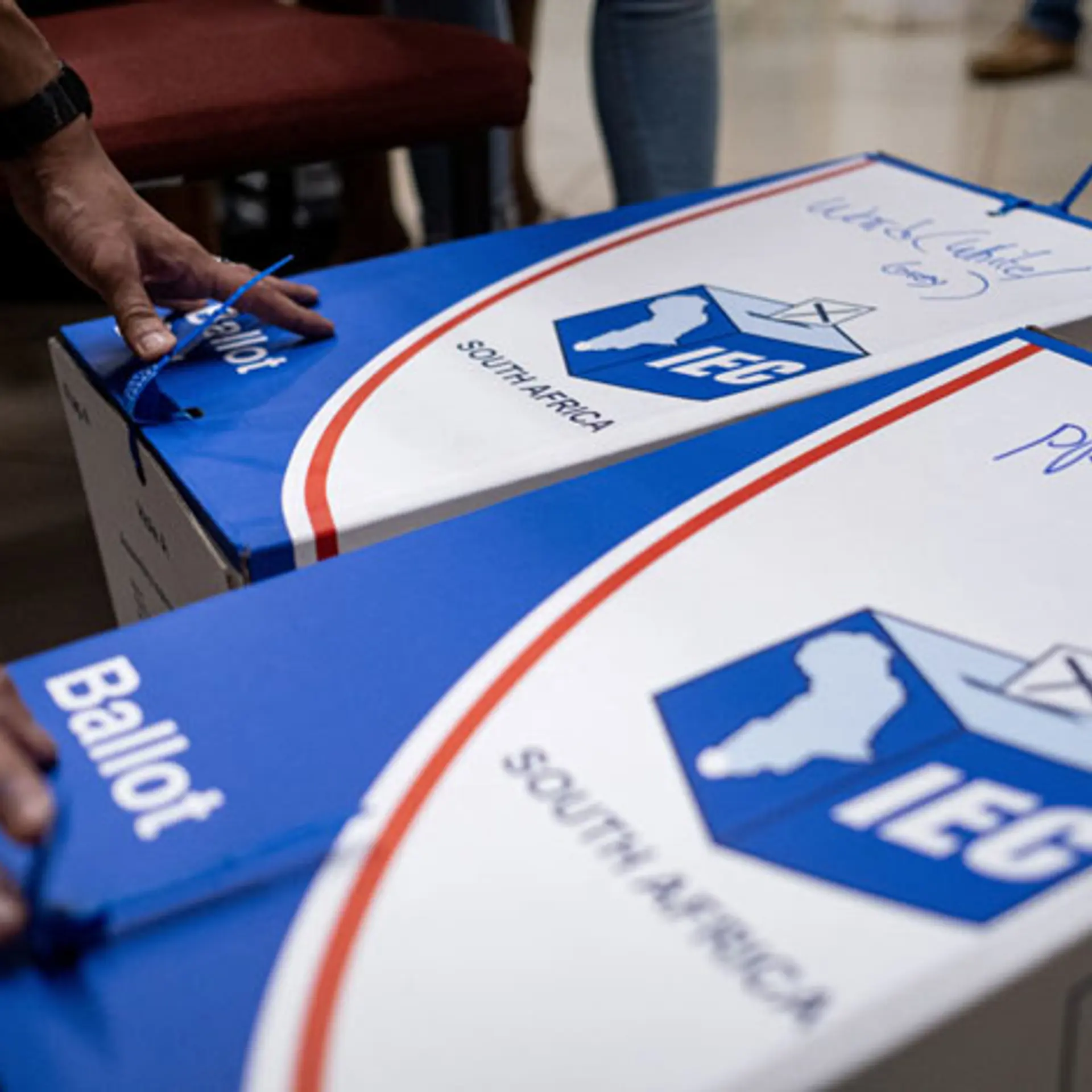
Picture: Emmanuel Croset/AFP
Emmanuel Croset/AFP
The next 14 days will reveal as much about the state of South Africa's democracy as the local government elections themselves. With 127 municipalities returning hung councils, political parties are preparing to negotiate coalition agreements that will determine who governs some of the country's most economically significant cities and towns.
Yet, beyond the language of cooperation, stability and shared governance, coalition negotiations often resemble the carving up of a political landscape according to power, territory and patronage, sometimes far removed from the everyday realities of the people who live there.
There is an uncomfortable historical parallel with the 1884–1885 Berlin Conference, when European powers negotiated territorial claims over Africa with little regard for the people who inhabited the continent. The circumstances are fundamentally different: today's coalition negotiations take place within a constitutional democracy, following a democratic electoral process.
Nevertheless, the analogy captures an important concern. Political parties risk treating municipalities as territories to be distributed rather than institutions entrusted with public service delivery and the development of the local economy.
Johannesburg, Tshwane, Ekurhuleni and Nelson Mandela Bay are not merely political prizes. They are economic hubs, centres of employment, infrastructure networks and service-delivery institutions. Yet, in coalition negotiations, their political value can be reduced to bargaining power.
A mayoral position in one municipality can become leverage for a speaker's position or a mayoral committee portfolio in another. The result is a political marketplace in which territorial control can take precedence over coherent governance programmes.
The 2026 elections have reinforced this fragmentation. The ANC retained its position as the largest political party nationally, but secured only 30.76% of the vote, followed by the DA at 24.64%. The MK Party received 9.76%, the EFF 6.22% and ActionSA 5.67%. The ANC's diminished electoral dominance, alongside the growth of opposition formations, has fundamentally changed the arithmetic of local government.
In Johannesburg, for example, the DA secured 91 of 270 council seats, the ANC 63 and ActionSA 43, leaving no party with an outright majority. The electorate has therefore produced a political landscape in which cooperation is unavoidable in many municipalities. This is not necessarily a democratic weakness.
Coalitions can encourage political compromise, broaden representation and compel parties to negotiate around shared priorities. The danger emerges when the negotiation process becomes an exercise in distributing political offices rather than establishing a common programme for municipal recovery and good governance.
While citizens cast their ballots, they have limited influence over the political arrangements that follow. Voters choose parties based on their manifestos, candidates and promises of service delivery. However, once the results are declared, the actual configuration of municipal leadership is negotiated between political elites.
A voter who supported one party may find their municipality governed through an arrangement involving parties they actively opposed. This is a legitimate consequence of proportional representation and coalition politics, but it creates a democratic accountability problem when the compromises that determine municipal leadership are neither transparent nor linked to measurable policy commitments.
The question is not whether political parties should negotiate. They must. It is whether those negotiations should be governed by transparent agreements that explain how political power will be exercised and how competing parties will be held accountable.
The proposed Local Government: Municipal Structures Amendment Bill of 2026, commonly referred to as the Municipal Coalitions Bill, provides an important starting point. Among its proposals is the requirement for written coalition agreements to be submitted to municipal managers and provincial authorities and published in the Provincial Gazette. However, the legislation is still undergoing parliamentary processing.
South Africa needs coalition agreements that go beyond distributing mayoral positions, speaker offices and MMC portfolios. They must establish measurable service-delivery commitments, dispute-resolution mechanisms, financial oversight responsibilities and consequences for parties that undermine agreed governance arrangements.
The most important consideration is ensuring that political instability does not become administrative paralysis. Municipalities must separate the political contestation of elected office bearers from the professional administration responsible for delivering water, electricity, sanitation, wa ste management and infrastructure maintenance.
The Department of Cooperative Governance and National Treasury have previously emphasised the importance of protecting municipal administrations from coalition instability. A change of mayor should not mean a wholesale change of technical personnel, municipal managers or departmental priorities.
Professional appointments must be based on qualifications, competence and merit rather than political deployment.
This is particularly important when considering the Auditor-General's 2024–25 local government audit findings. Only 39 of 257 municipalities achieved clean audits, representing 15% of the total. A further 116 received unqualified opinions with findings, while 87 received qualified opinions. The Auditor-General also identified persistent weaknesses in procurement, financial management, infrastructure maintenance and accountability.
These figures demonstrate that municipal government is already operating under considerable institutional pressure. Coalition negotiations that prioritise political appointments without addressing these weaknesses risk reproducing the very governance failures that contributed to voter dissatisfaction.
The recent Ekurhuleni controversies, involving allegations against senior administrative and law-enforcement officials, further illustrate the vulnerability of municipal institutions to governance failures. The criminal allegations involving City Manager Kagiso Lerutla and suspended Ekurhuleni Metro Police Department (EMPD) Deputy Chief Julius Mkhwanazi must be resolved through due legal processes. Nevertheless, the controversy reinforces the need for independent oversight, credible appointments and functioning internal accountability mechanisms.
During his testimony before the Madlanga Commission, Public Service Commission chairperson Professor Somadoda Fikeni described what he called the political economy of inefficiency: a situation in which political leadership presents an appearance of commitment to reform while practical implementation is obstructed by institutional interests and weak accountability.
His observation is relevant beyond the commission's immediate mandate. Municipalities cannot continue accumulating policies, coalition agreements and development plans while failing to translate them into functioning institutions. The Auditor-General's findings must therefore inform coalition priorities, budget allocations and municipal performance agreements. Audit reports should become instruments of corrective action, not annual exercises in documenting institutional failure.
Equally, democracy cannot end at the ballot box or be reduced to negotiations between political party leaders.
Residents must exercise their participatory rights through public hearings, integrated development planning processes, municipal oversight committees and budget consultations. Coalition governments should publish their agreements and report regularly on their implementation.
The 2026 elections have demonstrated that South Africa's electorate is increasingly unwilling to grant political parties unconditional authority. The emergence of 127 hung councils is not simply a challenge to political leadership; it is an opportunity to rethink how municipalities are governed.
The next 14 days should therefore be about more than deciding who occupies the mayor's office or controls the municipal purse. They should establish what kind of municipalities South Africans want to build.
The ballot box has distributed political power. The negotiating table must now translate that power into public accountability.
Otherwise, coalition politics will become another exercise in elite accommodation, where political parties divide the spoils of municipal government while residents continue paying the price for institutional failure.
Charles Matseke (MPhil in Politics and International Relations) is a researcher and writer with a keen interest in contemporary political dynamics. His research focuses on electoral politics, foreign policy analysis, and international relations, with a particular emphasis on the Global South and Africa's role in global affairs.