CHARLES MATSEKE | Towards the 2029 coalition realignment: SA’s new politics of power
'The country’s political restructuring should be understood as part of the natural evolution of a maturing democracy: a transition from one-party dominance towards a competitive multiparty system in which electoral legitimacy must increasingly be negotiated rather than inherited,' writes Charles Matseke.
Charles Matseke
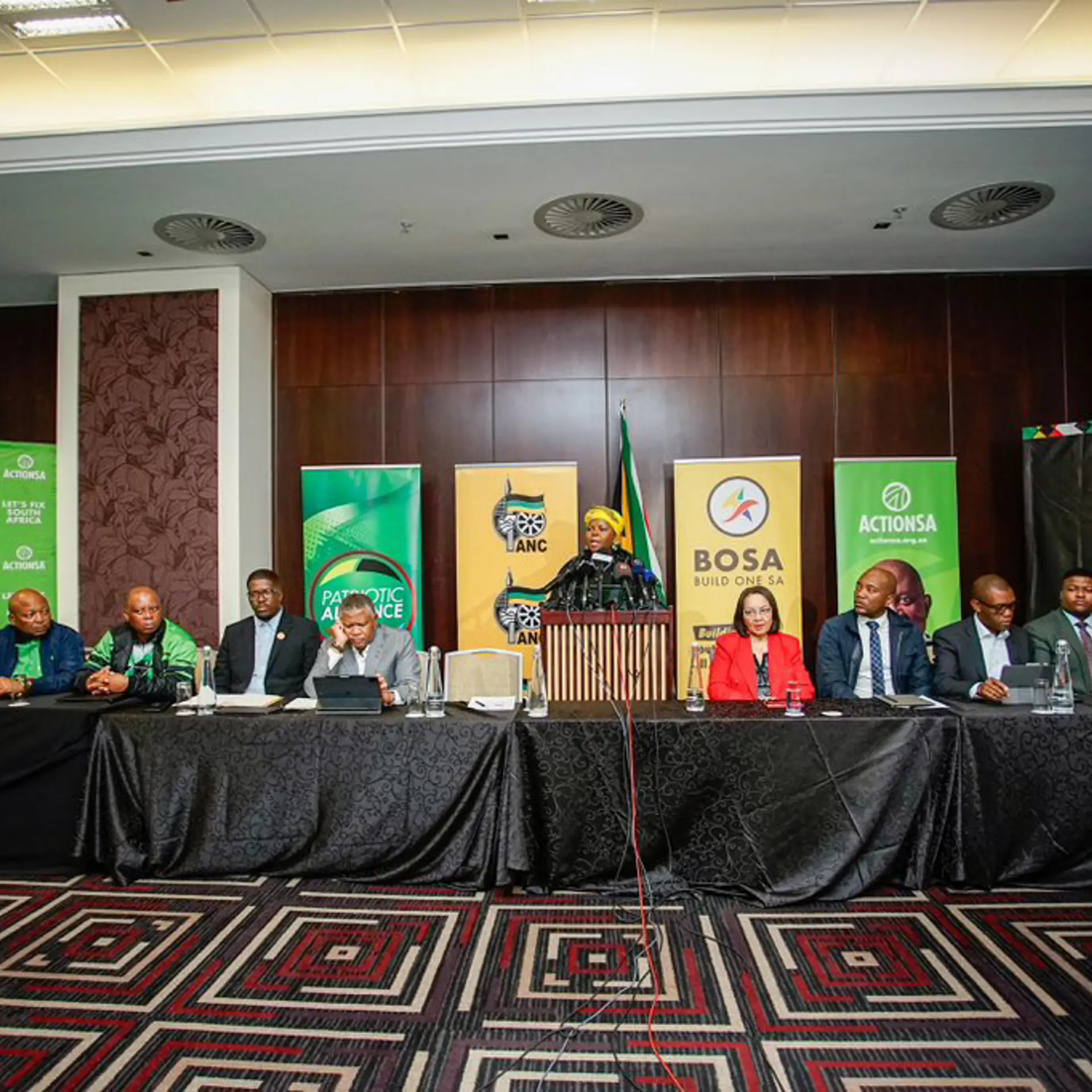
Political parties that passed the 2025 fiscal framework in Parliament held a media briefing on 24 April 2025. Picture: @MYANC/X
@MYANC/X
South Africa is witnessing a fundamental restructuring of its political landscape. However, this moment should not be understood merely as the decline of the African National Congress (ANC), once the country's dominant liberation movement.
It is better understood as part of the natural evolution of a maturing democracy: a transition from one-party dominance towards a competitive multiparty system in which electoral legitimacy must increasingly be negotiated rather than inherited.
The 2026 Local Government Elections have accelerated this transition. With the ANC securing approximately 31% of the vote, the Democratic Alliance (DA) around 25%, and 139 hung councils emerging across the country, coalition government has become an unavoidable feature of South African politics.
This fragmentation reflects accumulated public disillusionment with corruption, crony capitalism, cadre deployment and the deterioration of public institutions. Political office has increasingly become associated with access to state resources, patronage networks and private enrichment rather than public service. The erosion of political credibility has consequently weakened the historical loyalties that once sustained ANC dominance. But the more consequential question is not who has lost political power. It is how political parties intend to reconstruct it.
The immediate coalition negotiations provide an important indication of how political power may be redistributed ahead of the 2029 National and Provincial Elections. Gauteng, particularly Johannesburg, Tshwane and Ekurhuleni, has become the testing ground for competing coalition arrangements.
The ANC's emerging negotiations with ActionSA, potentially supported by the Economic Freedom Fighters (EFF), MK Party and smaller formations, could exclude the DA from all three metropolitan governments. The proposed arrangement, under which ActionSA could secure the mayoralties of Johannesburg and Tshwane while the ANC retains Ekurhuleni, illustrates the extent to which parties are prepared to redistribute executive positions to secure governing majorities.
This is politically significant because the DA emerged as the largest party in these metropolitan contests without securing outright majorities. Electoral plurality, however, does not automatically translate into executive authority. Coalition negotiations have exposed an uncomfortable distinction between winning the largest share of votes and possessing the political relationships necessary to govern.
ActionSA has consequently become a strategic kingmaker. Herman Mashaba's party is negotiating from a position in which its electoral representation carries disproportionate political value. The contest over Johannesburg's mayoralty, including the controversy surrounding Helen Zille's candidacy, demonstrates how individual political personalities can become bargaining instruments in broader institutional negotiations.
Yet the implications extend beyond municipal appointments. The ANC's willingness to explore arrangements with ActionSA, the EFF and MK Party suggests that the political architecture of the 2024 Government of National Unity (GNU) may not necessarily survive in its current configuration.
The GNU represented a compromise between political formations with fundamentally different economic and governance philosophies.
The ANC and DA's participation established a relatively moderate governing arrangement, bringing together centre-left and centre-right traditions within one executive.
However, the ANC's declining electoral support has intensified internal arguments about the political costs of its partnership with the DA. Some within the party increasingly view cooperation with the DA as alienating working-class and rural constituencies that remain central to the ANC's historical electoral base.
The emerging alternative could be a broader political alignment involving the ANC, EFF, MK Party, SACP and smaller nationalist formations. Such an arrangement would not necessarily represent ideological unity. Rather, it could reflect a strategic convergence around political interests, historical affiliations and opposition to the DA.
On the other side, the DA, Freedom Front Plus (FF+), Inkatha Freedom Party (IFP) and smaller constitutionally oriented formations could increasingly consolidate around market-oriented governance, institutional reform and constitutionalism. These are not yet established electoral blocs. Nevertheless, the emerging coalition arithmetic suggests that South Africa could be moving towards two competing political ecosystems ahead of 2029.
The critical question is whether these formations can develop coherent governing programmes or whether their relationships will remain transactional arrangements designed to secure access to executive power.
The DA also needs to confront an uncomfortable consequence of its own political strategy. For years, the party has campaigned against the prospect of an ANC-EFF-MK coalition, warning that such an arrangement would threaten constitutional democracy and economic stability. While this messaging has helped consolidate its electoral base, it has also narrowed its negotiating options in an increasingly fragmented political environment.
In proportional coalition politics, securing the largest share of votes is only the beginning of the negotiations. A party polling 34% in a municipality still requires additional partners to reach a governing majority. By treating the EFF and MK Party as politically untouchable, the DA has effectively surrendered potential negotiating combinations to its competitors.
The ANC, by contrast, has demonstrated a greater willingness to explore multiple configurations. This gives it considerable mathematical flexibility.
Consequently, ActionSA can negotiate from a position of strength, including making mayoral leadership a condition of cooperation. The DA's difficulty is not simply that other parties disagree with its policies; it is that its own political red lines have reduced the number of viable governing arrangements available to it.This has created an enemy-of-my-enemy dynamic. The ANC, EFF and MK Party have deep ideological and political differences, yet excluding the DA from municipal government can provide an immediate basis for cooperation. Their common political objective may temporarily outweigh their competing interests.
Reports of exploratory contacts between the DA and MK Party further illustrate the contradiction. After years of warning against such political arrangements, even exploratory engagement risks appearing inconsistent to its own constituency. The DA is increasingly caught between ideological purity and the practical requirements of coalition government.
ActionSA and the Patriotic Alliance (PA) occupy an increasingly important position in this emerging political landscape. Their influence demonstrates that coalition politics is not necessarily determined by the largest parties alone. Smaller formations can exercise disproportionate leverage when the larger parties cannot independently assemble governing majorities.
However, this influence comes with responsibility. The ability to determine who becomes mayor or which party controls a municipal department should not become an alternative mechanism for political patronage. Coalition agreements must prioritise service delivery, administrative stability and transparent accountability.
South Africa must also reconsider whether its municipal executive arrangements are adequately designed for sustained multiparty government. Proportional participation, collective executive structures and enforceable coalition agreements deserve serious consideration.
The next three years will determine whether South Africa's emerging multiparty democracy becomes a platform for institutional renewal or another arena for elite bargaining.
The ANC may discover that excluding the DA locally offers short-term political advantages but creates longer-term uncertainty for the GNU. The DA must confront the reality that electoral plurality does not guarantee governing authority.
ActionSA and the PA must demonstrate that their negotiating influence can translate into credible administration rather than political currency. South Africa is therefore approaching a new phase of coalition politics in which traditional boundaries between governing parties and opposition formations are becoming increasingly fluid.
The 2026 elections may ultimately be remembered not simply as the moment the ANC lost its dominance, but as the beginning of a broader political realignment. By 2029, the decisive question will not be which party has the strongest historical identity or the loudest electoral campaign. It will be which political formation can convince voters that it is capable of governing, delivering services and rebuilding public confidence in the state.
The age of inherited political authority is ending.
The age of negotiated political legitimacy has begun.
Charles Matseke (MPhil in Politics and International Relations) is a researcher and writer with a keen interest in contemporary political dynamics. His research focuses on electoral politics, foreign policy analysis, and international relations, with a particular emphasis on the Global South and Africa's role in global affairs.