From 'a better life for all' to 'let us fix it': Have political slogans lost their spark?
Former political correspondent Peter Mann says South Africa's election slogans have lost their punch, wit and imagination. So, what happened to clever political campaigning?
Kabous Le Roux
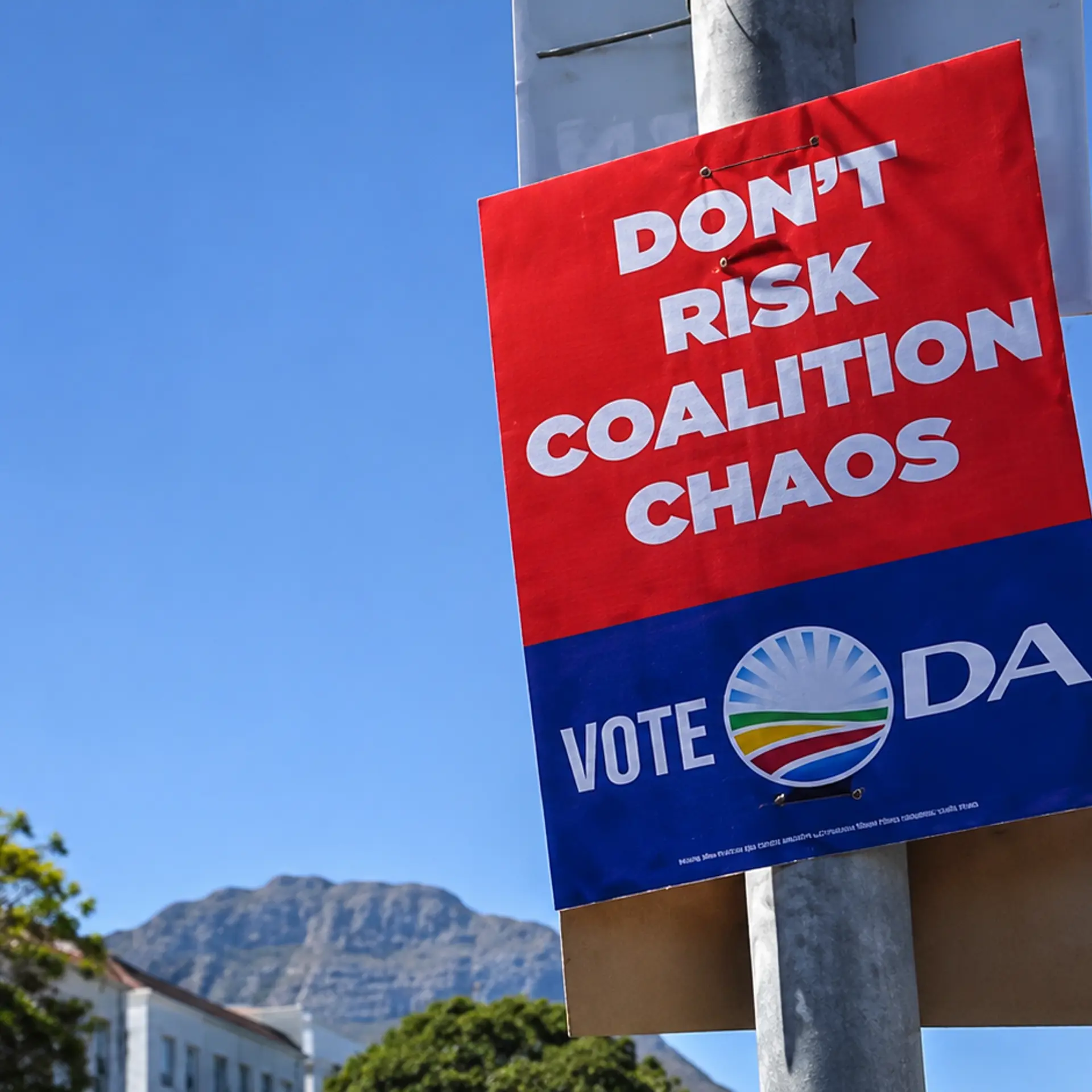
A DA election poster warns voters against the risk of coalition chaos, as political parties face scrutiny over their campaign slogans and messaging ahead of South Africa's local government elections.
South Africa's election posters are appearing across the country, but the slogans accompanying them seem to be generating little excitement.
From the ANC's familiar promises of building better communities to ActionSA's straightforward call to "let us fix it", political messaging appears to have lost some of the wit, creativity and ambition that once made election campaigns memorable.
Peter Mann, a former political correspondent and chief executive of Meropa Communications, believes political slogans have become increasingly uninspiring, with parties seemingly struggling to capture the public imagination.
Speaking to CapeTalk, Mann said election slogans should intrigue voters, entice them to participate and communicate something meaningful about the country's direction.
"Political slogans seem to be dreadful to me this time around," he said.
Mann believes political parties have not brought enough imagination to their messaging, particularly given the importance of the local government elections.
RELATED: eThekwini municipality takes down controversial 'water tanker mafia' billboard
From aspirational politics to transactional promises
South Africa's earlier political campaigns featured slogans that sought to communicate a broader vision.
The ANC's "A better life for all" became one of the defining messages of the democratic era, while the Democratic Party's "Fight Back" campaign offered voters a short, memorable rallying cry.
Mann contrasted those messages with the slogans being used in the current election campaign.
The ANC's message includes "building better communities together", while the DA has used "moving forward, we can move on together".
The Freedom Front's "It's time" also came under scrutiny from Mann, who questioned what the slogan was actually intended to communicate.
He argued that campaign messaging should move through different phases, starting with building awareness, followed by encouraging supporters to vote and, eventually, highlighting the perceived risks of an opposition victory.
However, he believes many parties have struggled to make their messages distinctive.
Mann also pointed to the difference between aspirational and transactional political messaging.
"Yes, it is transactional now," he said.
He argued that campaigns increasingly focus on practical promises and negative messaging rather than offering voters a compelling vision of what the country could become.
Are political parties running out of money?
The quality of election posters may also reflect the financial pressures facing political parties.
During the interview, the question was raised about whether campaigning has become so expensive that parties can no longer afford the expertise needed to develop distinctive slogans and advertising campaigns.
Mann agreed that money was a significant factor.
He pointed to the scale of the local government elections, noting that approximately 620 parties and 137,000 candidates were contesting 10,500 seats.
Posters remain an important way for parties to establish visibility and awareness, but Mann suggested that some of the more effective campaign messaging was being heard on radio rather than seen on roadside posters.
He singled out a DA radio campaign referencing Beaufort West having had five mayors and the problems in Knysna, as well as its "Stop the chaos" message.
Mann also suggested that some parties appeared to be relying on AI-generated posters to develop their campaign messaging.
When political slogans become a punchline
Some of Mann's sharpest observations concerned the physical condition of election posters.
He questioned ActionSA's "Let us fix it" slogan, pointing to posters that were sliding off poles and lying in crumpled heaps.
"If your poster is falling down, if you can't fix your poster, how are you going to fix the country?" he asked.
He also questioned the messaging of the Cape Exit Party, which advocates making Cape Town independent of the rest of South Africa.
Mann suggested that its promise to lower rates and taxes appeared to offer voters a fallback position rather than a convincing argument for independence.
He contrasted the current campaign messaging with the memorable 1979 British Conservative Party slogan "Labour Isn't Working", which he described as clever because it communicated a political argument in just three words.
For Mann, that kind of concise, memorable messaging is largely missing from South Africa's current election campaigns.
With local government being the level of government responsible for delivering many of the services that affect people's daily lives, he believes parties should be bringing their best ideas to voters.
Instead, he said, the election campaign has been characterised by uninspiring slogans and a lack of creativity.
The question is whether political parties can still find the words to make voters stop, think and take notice.