LGE 2026: How proportional representation determines party power in municipal councils
The IEC’s final seat allocations will be crucial in determining the balance of power, with coalition talks expected to begin after Sunday night’s formal announcement.
Dimakatso Leshoro
The ward seat goes to the candidate who receives the most votes. Photo: AI illustration
AI illustration
As the dust settles on South Africa’s 2026 local government elections, all eyes are now on the IEC and how it will turn votes into council seats.
The battle for control of municipalities is not just about which party has won the most wards, but also how many seats each party secures through the proportional representation system.
Governed by the Municipal Structures Act, the system combines directly elected ward councillors with PR councillors appointed from political party lists.
The IEC’s final seat allocations will be crucial in determining the balance of power, with coalition talks expected to begin after Sunday night’s formal announcement.
Currently, 135 councils are hung, meaning no single party has secured an outright majority.
For political parties, every seat counts as they position themselves for coalition negotiations and the chance to govern.
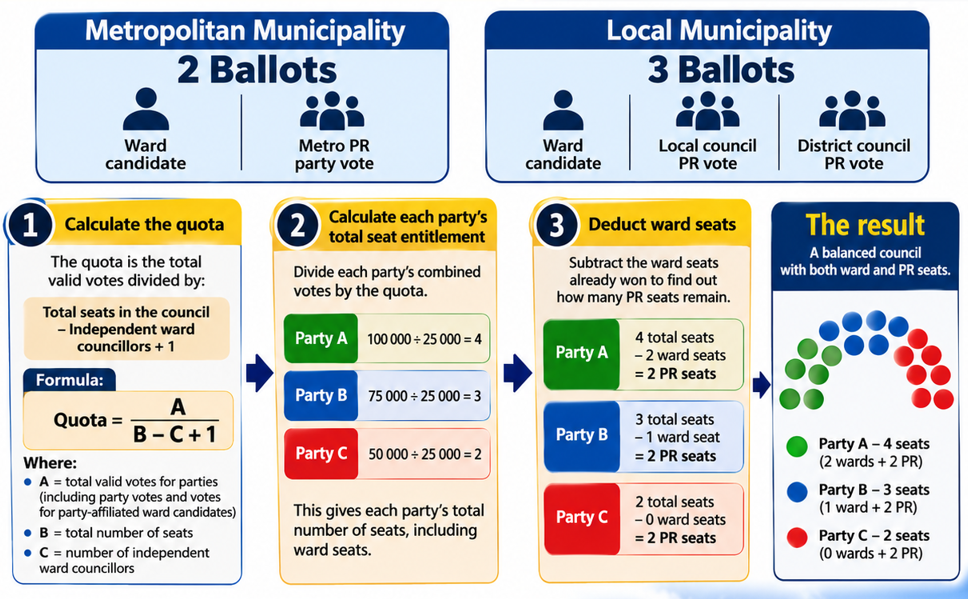
Metro voters receive two ballots; local municipality voters receive three. One ballot is for their preferred ward candidate and another for the political party they want represented in council.
The ward seat goes to the candidate who receives the most votes.
The remaining seats/PR councillors are allocated from party lists according to the proportional representation system.
The IEC first calculates how many seats each party is entitled to and then takes into account the ward seats already won before allocating the remaining seats through party lists.
IEC’s Mmakgabo Ramatlhodi explained: “That calculation takes into consideration the total valid votes cast in that municipality. We divide by the number of seats in the council, less the number of independent ward councillors elected, plus one. The result of that is what we call a quota. We then go to each party that has received valid votes. We take the quota and divide that quota for each so that we can know how many seats each party qualifies for.
If, for example, a party has received 100,000 votes and the quota is 25,000, it means the party will receive four seats.”
This means a party does not have to win many wards to secure strong representation in council.
With so many councils hung, the final seat allocation will be decisive in determining which parties ultimately have the numbers to form coalitions and govern.