Local Elections 2026: DA surges, ANC slides and metros face massive coalition test
A side-by-side comparison of the 2021 and 2026 municipal elections so far reveals a stark divergence in metropolitan performance.
Eyewitness News
Local Elections 2026: DA surges, ANC slides and metros face massive coalition test
Five years ago, South Africans voted in a pandemic-hit local election that birthed a record number of hung councils.
In 2026, voters returned to the polls in higher numbers, not just to voice their frustration over crumbling municipal services, but to completely realign city halls.
From the MK Party's aggressive push into eThekwini to ActionSA's explosive surge in Tshwane, the battle for the metros has completely rewritten the playbook for local governance.
The numbers don't lie; the country's cities are moving decisively into a permanent multiparty era.
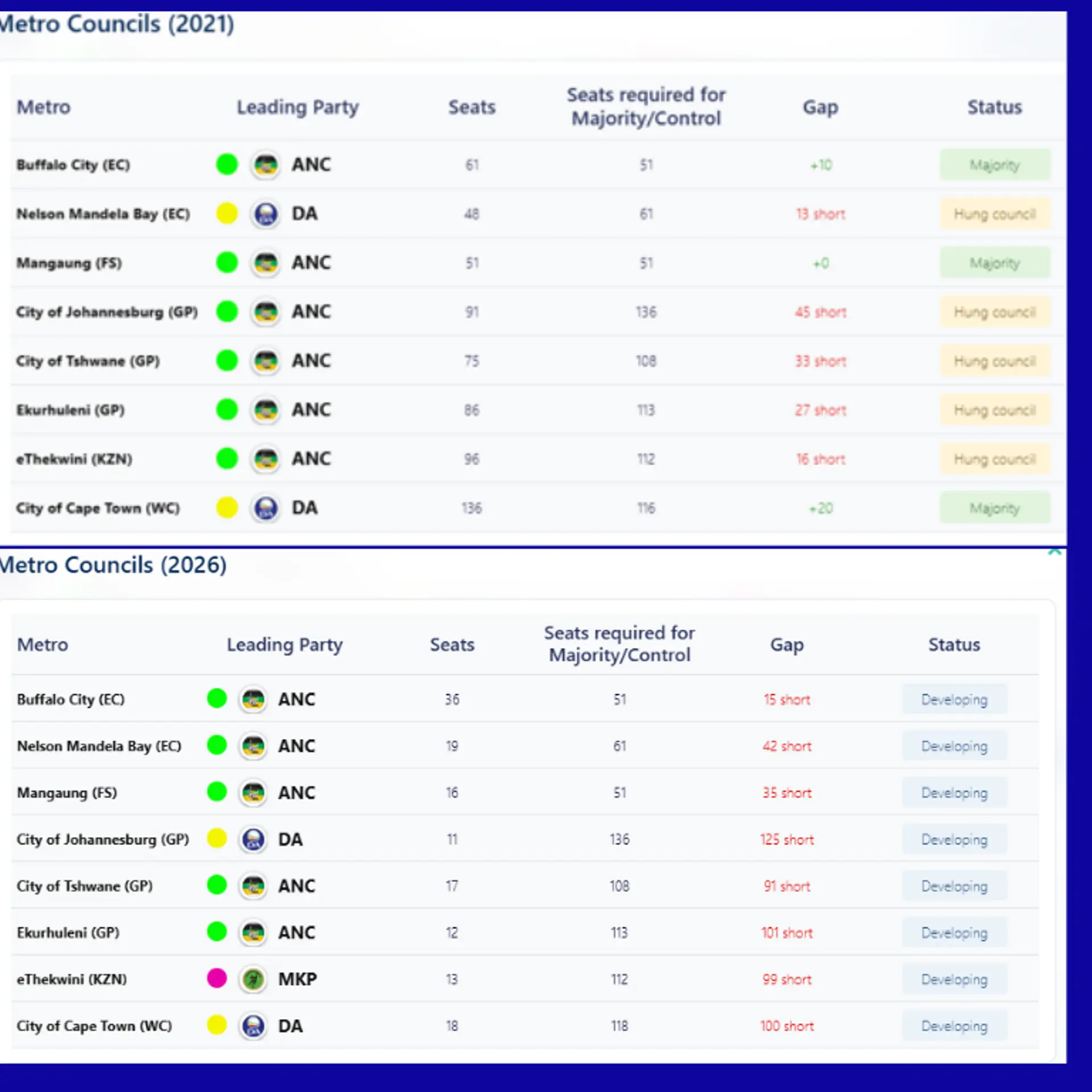
A side-by-side comparison of the 2021 and 2026 municipal elections so far reveals a stark divergence in metropolitan performance. While the ANC's national footprint moved further toward historic lows, the DA has solidified key strongholds and surged in others, leaving almost all metros bound to complex coalition negotiations.
2021 vs 2026
In 2021, the ANC fell below 50% nationally for the first time, getting 45.6%. In 2026, initial data shows the ANC sliding further to roughly 32% nationally on the proportional representation (PR) ballot, with the DA climbing to around 25%.
Metro-by-Metro Performance Breakdown
Gauteng Metros (Joburg, Tshwane, Ekurhuleni): In 2021, these were highly fragmented hung councils. In 2026 so far, the DA has taken commanding leads on the PR ballot in Joburg with roughly 40.15% and Ekurhuleni with 29.67%.
Tshwane: Meanwhile, Tshwane has become an intense battleground with ActionSA surging significantly with 23.4% compared to its 2021 baseline, but is now following behind the DA after initially taking an early lead when very few votes had been counted. The DA is currently sitting at roughly 31.58%.
Cape Town: The DA held an outright majority in 2021 (58.3%) and has widened that gap in 2026, capturing over 60% of the early vote.
eThekwini: A hung council in 2021, the 2026 election marks a major disruption here with Jacob Zuma’s uMkhonto weSizwe (MK) Party emerging as the dominant force, sitting at 34.37%, having taken over previously ANC-dominated areas. With 68% of the vote tally in KwaZulu-Natal, the uMkhonto weSizwe Party is leading in 12 municipalities.
Mangaung & Nelson Mandela Bay: Both shifted away from tight 2021 margins. In 2026, the DA built comfortable leads in both councils, roughly sitting at 35.86% and 44.59% respectively.
Buffalo City: The ANC continues to take the lead at more than 40%; however, data from the Electoral Commission of South Africa (IEC) shows that the party has dropped significantly from the 2021 outright majority lead, failing to meet the 50% threshold, meaning the municipality could lead to a hung council.
In 2021, coalitions were volatile and frequently collapsed. Because the DA is projected to win an outright majority only in Cape Town, the 2026 results mean that the other seven metros will require intense coalition agreements to form stable governments.
The Electoral Commission of South Africa (IEC) is expected to announce the final results of the 2026 local government elections on Sunday, 9 November.