MALAIKA MAHLATSI | “No water, no vote!” – The opportunistic reframing of the Gauteng water crisis
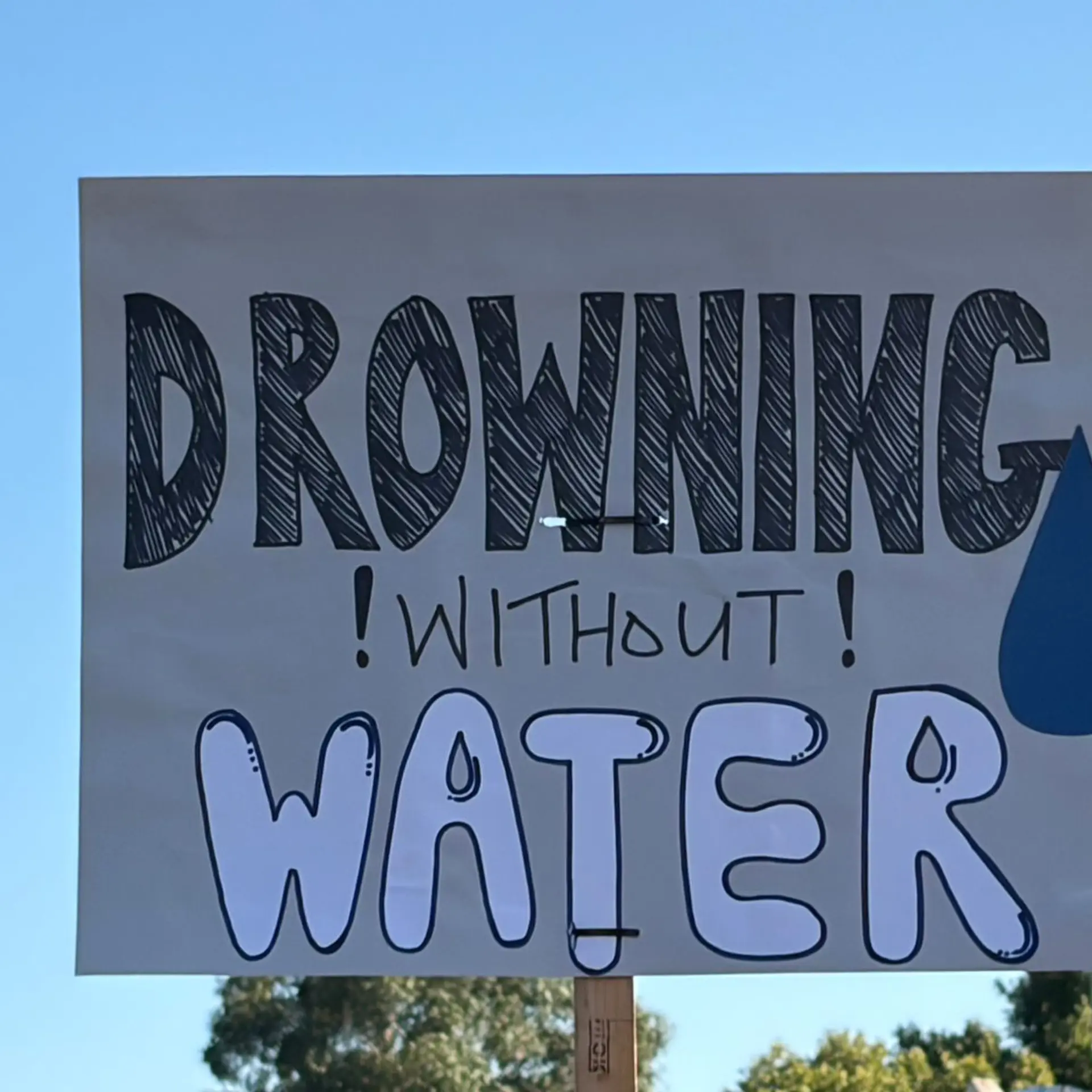
Echoes of “No water, no vote!” are spreading across the province as residents assert their refusal to participate in an electoral process that is central to the democratic project while they are being denied the most basic of public goods in a democracy: water.
Malaika Mahlatsi
Joburg residents protest in different parts of the city on Wednesday, 11 February 2026, due to prolonged water outages. Picture: Dimakatso Leshoro/EWN
Dimakatso Leshoro/EWN
Less than a week before the country goes to the polls to decide the future of its local administrations, the wealthiest province in South Africa is battling a water crisis that is bringing households and businesses to the brink.
Communities from Hammanskraal to Verulam, KwaMhlanga to Bronkhorstspruit, and Ratanda to Heidelberg are dealing with dry taps, unchlorinated water, and reliance on unreliable water tankers.
In Johannesburg, the economic nerve centre of the national economy, a city that contributes over 17% of the country’s Gross Domestic Product (GDP), protests have erupted across numerous communities.
From Melville to Crown Gardens, Kensington to Soweto, communities have taken to the streets to protest weeks of inconsistent water supply.
Echoes of “No water, no vote!” are spreading across the province as residents assert their refusal to participate in an electoral process that is central to the democratic project while they are being denied the most basic of public goods in a democracy: water.
At any other time, this ongoing water issue would be a serious crisis, but the fact that it is happening in the middle of a devastating El Niño cycle has made it a catastrophe that is literally putting people’s lives at risk.
Consider the situation at St Giles Association for the Physically Disabled in Dewetshof, near Kensington, where tens of frail and physically disabled residents' emergency reserves of 25 litres per room run out in the early morning.
Dirty linen could not be washed.
Physically disabled individuals battling incontinence and needing to be given multiple showers a day could not be bathed.
Toilets could not be kept clean. Had it not been for members of the community, themselves battling water challenges, donating water bottles and filling up 25-litre containers for the facility, the most vulnerable people in our society would have been exposed to all manner of diseases, some of which have outbreak potential.
This is but one case.
In an article published here on Monday titled “El Niño is demonstrating why water infrastructure failures in SA municipalities are catastrophic”, I provided a comprehensive explanation of what the said climatic phenomenon is, and its impact on South Africa’s already constrained water resources.
I also quote the statements of the South African Weather Service (SAWS), which has confirmed that the extreme heat that Gauteng has been experiencing over the past weeks will continue through the spring and summer.
That South Africa is a dry semi-arid region is an established scientific fact.
According to the United Nations Food and Agriculture Organization (FAO), over 80% of our land surface falls into the arid, semi-arid, or dry sub-humid categories.
Gauteng itself is not a semi-arid desert or scrubland like the Northern Cape or parts of the North West province.
It is part of the country’s Grassland Biome, which is characterised by a subtropical highland climate.
But the province, which is the most populous in the country, relies heavily on water imported from outside its borders, such as the Vaal River system and the Lesotho Highlands Water Project.
This makes it extremely vulnerable to water scarcity.
Over the past few days, as elections draw near, municipalities and political parties have been playing politics about this very serious situation.
The manufacturing of scapegoats has been absolute.
Three days ago, the City of Tshwane published a statement addressing several water-related challenges simultaneously.
These include the ongoing contamination crisis in Bronkhorstspruit, water-quality concerns in parts of Hammanskraal, infrastructure failures and supply restrictions affecting other parts of the metro.
In its attempts to explain the crisis, the city states: “The current supply challenges are primarily the result of critically depleted reservoir levels, reduced supply from Rand Water and high water consumption, rather than an ongoing major leak”.
This same line of reasoning was also employed by the ANC Greater Johannesburg Region in a statement released on the 29th of October, which alleges some conspiracy on the part of Rand Water to intentionally destabilise water supply.
The statement argues that “Rand Water must appreciate that the timing of its decision creates legitimate grounds for public scrutiny” and that the institution must “dispel any perception that its actions could undermine public confidence during this critical election period”.
While it published a statement a day later walking back these damning claims, and correctly attributing the challenges to systemic poor water governance and biological factors, mainly the El Niño cycle, the die has been cast in so far as cementing a perception that the bulk water utility is playing politics with people’s lives.
The facts on the table are clear and residents of Johannesburg and Gauteng, broadly, deserve to have them. The reality of the situation is that water supply has been restricted owing to three fundamental and interlinked problems.
Firstly, the El Niño cycle is characterised by low rainfall and high temperatures.
Direct surface evaporation from open water sources such as reservoirs, lakes, and rivers has accelerated sharply during El Niño, which is rapidly depleting water supplies.
Secondly, there are high levels of consumption of these constrained water supplies across much of the Gauteng Province. Since January this year, the City of Johannesburg has been using 194 megalitres a day above its temporary water-use efficiency target, and nearly 500 megalitres a day above its permanent target.
The City of Tshwane has also been exceeding its temporary water-use efficiency target by around 150 megalitres a day, which is more than 200 megalitres a day above its permanent target.
Even the City of Ekurhuleni that fares better, and has remained below its temporary water-use efficiency target, has been using above its permanent target by over 40 megalitres a day.
Thirdly, and linked to the second point, the exceeding of the consumption is driven largely by poor water governance, particularly as it relates to the deterioration of water infrastructure owing to municipal failures.
Approximately 431 billion litres of treated water a year are physically lost through leaking and burst pipes in Gauteng.
To put this into context, roughly one in every two litres of treated water produced for Gauteng does not generate revenue due to physical leaks, illegal connections, water theft, or unbilled/inaccurate metering.
The City of Johannesburg has 49% non-revenue water, of which 29% is due to physical losses. The City of Tshwane has 45% non-revenue water, of which 34% is due to physical losses.
The City of Ekurhuleni has 30% to 32.5% non-revenue water, of which 22% is due to physical losses.
Those are only the metros.
The situation is far worse in local municipalities, with non-revenue water in Mogale City and Emfuleni local municipalities at 60% and 70%, respectively.
This is the scale of the poor water governance crisis, and it is happening at the municipal level.
As elections draw near, municipalities and political parties want residents of Gauteng to be confused about what their massive role in the crisis has been.
This confusion is what has enabled the scapegoating of bulk water utilities. In reality, local storage, reticulation, distribution, customer services and water losses are managed by municipalities, not Rand Water.
The water board is responsible for conveying raw water, treating it to drinking-water standards and supplying it in bulk.
What it can treat and supply is dependent on the abstraction allocations that are managed by the national Department of Water and Sanitation.
These allocations are informed by legislation, specifically, the National Water Act (NWA) No. 36 of 1998, according to which it is a distinct criminal offense for water utilities to abstract more water than permitted.
There are legislated statutory penalties for violating this law, including but not limited to convictions resulting in a fine and/or imprisonment for up to ten years (or up to five years for a first conviction).
For a continuing offense, the court can issue a daily compounding fine for each day the unlawful abstraction continues.
But it doesn’t end here.
Under public environmental legislation, directors, municipal managers, or senior executives can face personal criminal charges if they intentionally or negligently fail to prevent the bulk water utility from violating its legal water use license.
Therefore, to claim that Rand Water restricting water supply on account of over-consumption is a political conspiracy is not only a false argument, but it is also a dangerous one that is effectively demanding the utility to break the law.
Contrary to their attempts at feigning confusion and claims that they have been blindsided by the restrictions that Rand Water has implemented, municipalities and political parties knew about the situation and have known for a long time.
The high consumption rates have been ongoing for years, with warnings by water experts being ignored by politicians and officials in municipalities.
Additionally, data on consumption rates has been publicly available to them for at least four years – that is how far back Rand Water has been publishing weekly water consumption statistics on its website.
Municipalities have had the same access that we in the water research community have had all these years.
They knew what was happening.
They knew that deteriorating infrastructure is causing non-revenue water levels to increase and that it is costing the provincial economy billions in lost revenue annually.
They knew.
And now, as the crisis implodes, they are being politically expedient and wanting to manufacture scapegoats.
This disregard for us as Gauteng residents is the reason communities have placed water as one of the key electoral issues.
Water is going to play a role at the ballot.
For some, the vote will be for an end to the poor governance and rot that has decimated our municipalities.
For others, the decision not to cast their ballots, which in itself is a vote, comes down to the fact that a democracy that cannot deliver water is not worth defending.
And that is the worst indictment of what our country is being allowed to become.
Malaika is a water governance researcher with an MSc in Water Resource Science from the Institute for Water Research. She is a PhD candidate in Geography at the University of Bayreuth in Germany.