MALAIKA MAHLATSI | The vulgar opportunism of ‘Blacks parties must unite’ politics
‘The assumption that ‘Black parties’ are inherently progressive is dangerous because it refuses to engage with the reality that a party being led by Black people does not inherently have Black interests at heart,’ writes Malaika Mahlatsi.
Malaika Mahlatsi
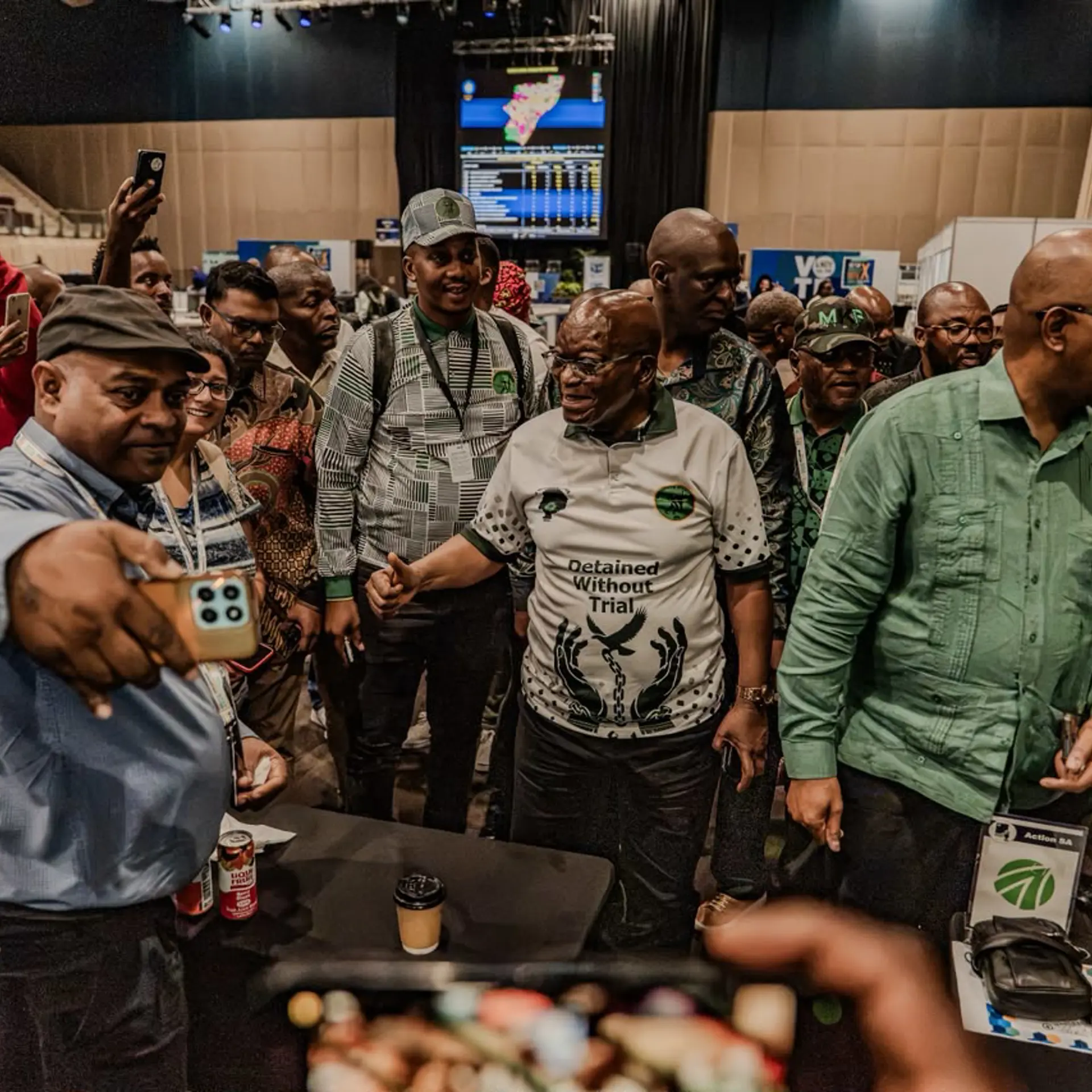
MK Party leadership arrives at the ROC in Midrand. Photo: Sphamandla Dlamini
Sphamandla Dlamini
On Saturday, four days after the main local government elections took place across South Africa, and during the counting and verification phase of the results, the Economic Freedom Fighters (EFF) and African National Congress (ANC) held media briefings at the national Results Operation Centre (ROC) at Gallagher Convention Centre in Johannesburg. The uMkhonto weSizwe Party (MKP) held a similar briefing at the ROC in eThekwini. The three parties were providing reflections on their performances in the 2026 Local Government Elections (LGE) that have reshaped the political environment in South Africa.
The ANC’s dismal performance saw it lose its majority in all metropolitan municipalities, and its national share of voter support declined by two digits. In the previous LGE in 2021, the ANC won. It secured 40.18% of the national vote in the 2024 general election. The EFF, while growing numerically in some wards, has also seen a steep decline in its overall support. In the previous LGE, it won 10.32% of the national vote, becoming the third largest political party in the country behind the ANC and the Democratic Alliance (DA).
That support declined slightly in the 2024 general election, where it won 9.52% of the national vote. The MKP did not exist in the previous LGE, but compared to its 2024 general election performance, where it won 14.59% of the national vote and 45.35% in the KwaZulu-Natal province, its support has declined. In the current election cycle, with 99% of the votes counted, the party is sitting at 9.76% of the national vote, with 34.31% support in KwaZulu-Natal, its stronghold.
Listening to the media briefings of the EFF and MKP in particular, and to the members of the ANC, a salient argument that is emerging is that there is a need for “Black parties” to unite. EFF leader Julius Malema emphasised this, arguing, as usual, that the DA is a representative of White interests and Zionist aspirations. Of course, he has conveniently forgotten that the EFF played an instrumental role in providing the DA with support in the not-too-distant past, voting with the party to keep the ANC out of councils in various metropolitan municipalities.
The same Malema who today vilifies the ANC for entering into a Government of National Unity (GNU) with the ANC and other parties once had a similar, albeit less formal arrangement with the DA.
He also argued that the ANC was effectively a worse danger to Black people than the DA and saw nothing problematic in imposing support to the DA in councils. I use the word imposing because at the time, the DA leadership had stated without equivocation that they did not want EFF support. The EFF insisted on giving it, keeping the DA in power in key metropolitan municipalities. That Malema failed to account for this history during his media briefing at the national ROC speaks to the opportunistic way in which the question of Black unity is often engaged.
The MKP has stated that it would only enter into coalitions with parties that are invested in the prosperity of Black people. Its leader, Jacob Zuma, discovered pro-Blackness when he was no longer in power. While he was, the condition of native remained a nervous condition.
The MKP is very vocal on land reform in particular, arguing that its mission is to return land to Black people.
This is rather curious, given Zuma’s track record with land reform when he had the most power to advance it. Assessments of land reform during his presidency, from 2009 to 2018, consistently highlight a glacial pace of progress and institutional failures.
In 2010, at the height of his power and support, the Land Restitution Commission suffered constraints so significant that it was forced to freeze land acquisitions temporarily after the depletion of its very limited budget allocation. The Presidency, which he led, could not even reconcile its own data to provide progress on land reform, which independent research would ultimately expose as almost non-existent. That this same man now leads a party that is anchoring its fate on the land question is rather curious.
While ANC leaders have not been as blatant in their own reflections, with Fikile Mbalula mainly focusing on the state of the organisation during his own media briefing, the party’s members have been publicly calling for the party to prioritise coalition talks with other “Black parties”.
This idea of Black unity has been hanging over the 2026 LGE, with prominent persons such as former EFF spokesperson and Member of Parliament, Dr Mbuyiseni Ndlozi, stating that he did not cast a vote in the election due to the disunity of “Black parties” and the atomisation of Black people. But as I sat at the national ROC listening to the EFF media briefing, I couldn’t help but question this “Black parties must unite” argument. On the surface, it seems like a simple argument, but when you reflect deeper, the fault line begins to emerge.
First and foremost, what exactly determines a “Black party” in the South African context? Those arguing for “Black unity” seem to suggest that any party that is led in its majority by Black people constitutes a Black party. In this context, nearly all the 542 parties that contested in this election are Black parties. But there is a serious problem with this logic, and it is that it uses Blackness alone as a measure of progressive politics that prioritise the interests of Black people. But nothing could be farther from the truth. Political parties are not inherently progressive on account of being led by Black people, for the simple reason that Blackness does not accord anyone inherent progressiveness.
The ANC that voters are overwhelmingly rejecting governed South Africa for decades, and while some of its policies are certainly progressive, it is also a party that presided over worsening income disparities and a highly racialised economy and labour market in which Black people are on the receiving end. While some of this is linked to the persistent legacy of apartheid, the ANC’s shift towards neoliberal policy in the mid-1990s played a significant role. This, alongside poor governance, has had a devastating impact on Black people.
Secondly, defining a party as a “Black party” on account of a Black leadership composition disengages from the very important question of precisely which Black interests are being protected and advanced. Based on the narrow definition of a Black party being one led in its majority by Black people, ActionSA and the Patriotic Alliance are Black parties. But these are the same parties whose posture is largely defined by an anti-immigration sentiment and blinding hostility towards African immigrants in particular.
I have written extensively about the dangerous Afrophobic politics of both parties. The reality of the situation is that the majority of immigrants in South Africa, both documented and undocumented, are Black. How does the “Black parties must unite” narrative reconcile with parties like these, which demonise, criminalise and scapegoat Black immigrants for the structural challenges that South Africa is confronted with?
The assumption that “Black parties” are inherently progressive is dangerous because it refuses to engage with the reality that a party being led by Black people does not inherently have Black interests at heart, and that such a party may even be harmful to Black people. History provides us with an example of the Inkatha Freedom Party (IFP), a party that caused untold suffering to Black people in Gauteng and KwaZulu-Natal in particular. And this suffering didn’t just happen in the late 1980s and early 1990s; it persists to this day precisely because the IFP continues to maintain denialism over its maiming and killing of Black people in the townships of said provinces. Its historical revisionism is harmful for many reasons, not least because its victims continue to be denied justice or even basic recognition for their suffering.
Consider too the ANC, once a proud national liberation movement that represented the aspirations of Black people, that has today evolved into a party that, in very many ways, has been harmful to Black people. You only have to look at where it has governed poorly, in provinces such as the Eastern Cape, the North West, the Free State and others, to understand who pays the price when a party morphs into what the ANC has become. In Johannesburg, where it has been governing through a coalition, the people who pay the heaviest price for poor governance are not the wealthy and upper middle-class in suburbs, but the working-class poor in townships and rural areas who do not have the same degree of resilience to withstand a collapsing system.
Our engagement with the concept of “Black parties” demands greater nuance than the current discourse has provided. There has to be deeper conceptualisation of what constitutes a Black party, and it has to be more than simply the racial composition of its political leadership. Being a Black party is not merely a declaration enveloped in populist rhetoric. It is a philosophical stance that is deeply rooted in the pursuit of epistemic, economic, political, spatial, environmental and all forms of justice for ALL Black people, including African immigrants, both documented and undocumented.
It is an ideological posture that doesn’t simply reject White paternalism in all its manifestations, but one that fashions a higher civilisation through investment in progressive institutions, policies and practices, for the advancement of Black liberation in a White normative society. But it is also rooted in practical solidarity with the oppressed people of the global majority – whether they be African, Latino/Latina, Palestinian, Rohingya, Romani, or First Nations people.
As coalition talks get underway and the politics of “Black parties must unite” find expression and resonance in light of the impressive performance of the Democratic Alliance, we must refuse to have our Blackness weaponised against us by those who want to advance unity that is not anchored on something concrete. “Black parties” uniting means nothing when they reproduce politics and practices that harm Black people. It means nothing when those parties espouse the very Verwoerdian logic that has led to the atomisation of Black people.
We must not fall into the trap of being mobilised by opportunists who only remember the value of Black unity when their council seats are at stake, but whose history is littered with examples of collaboration with White racists who have never deemed us as nothing but sub-human. There is no question in my mind that Black unity is crucial - but that unity must be based on principle and progressive politics. What we’re hearing right now is not Black unity rooted in our collective aspirations, but the cries of “Black parties” that are unaccountable for their harmful actions on Black people and appealing to emotions to cling onto power. Black people shall and must continue to reject this vulgar opportunism.
Malaika is a geographer and researcher currently providing live analysis of the 2026 Local Government Elections for EWN at the National Results Operation Centre in Johannesburg.